Newsletter
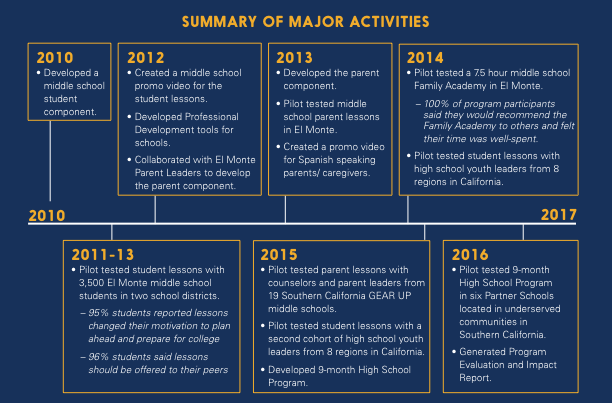
Summary of CAIC Activities
100 percent of students and parent program participants reported that they would recommend the Family Academy to others, that they would like to learn more, and that their time had been well-spent.
School counselors and parent leaders said that the three 90-minute lessons and activities were appropriate for parents, and recommended that the lessons to be translated into Spanish so they could be pilot tested with Spanish-speaking parents.

Investing in Public and Private Resources
Investment of Public and Private Resources: To create sustainability for the CAIC initiative, an investment of public and private resources is needed as well as a multi-pronged fundraising approach that includes multi-year foundation grants that will support the development of the core program, capacity building, and the delivery of direct services to students and their families. Additionally, “corporate partners” who are willing to commit to supporting our programs and signature events for up to three years are critically important.

Effective collaboration and networks: Strengthening existing relationships with collaborating partners and identifying new networks and organizations that share our commitment to youth development and collective action to scale and amplify this collaborative effort is a key to expanding this initiative.
Leveraging technology: The ability to leverage instructional technologies to extend instruction beyond the traditional classroom settings is necessary to scale-up this initiative. Equally important, linguistic experts are needed to strengthen our capacity to meet the instructional needs of California’s diverse multi-lingual communities. For example, at Rosemead High School, parents speak five languages, including English, Vietnamese, Cantonese, Mandarin, and Spanish, with approximately 300 monolingual parents that speak each language. As such, the use of professional interpreters and translation headsets to improve our instructional practice and learning outcomes is needed in this type of multilingual environment.
Accountability framework: Currently, no branch or group is responsible for ensuring that students graduate from high school college- and career-ready. Millions of dollars are allocated to fund Local Control and Accountability Plans and student success initiatives. In the 2016-17 State Budget, $200 million was allocated to Local Control Funding Formula Plus school districts to increase the number of low-income students who are eligible for California’s public universities. School districts contract with a variety of college access partners, nonprofit organizations, and vendors to help them reach their goals and provide more services to high-need students. Unfortunately, there are no comprehensive standards for the college and career planning curriculum that is taught to students, no quality control or transparency of instructional materials used, nor the requiring of evidence that learning outcomes are being met. Equally important, California schools are not required to help students discover their personal interests or to show them ways to match their personal interests to career options so that students can develop an education plan to propel themselves forward.
PROFESSIONAL DEVELOPMENT: If educators are required to meet these goals, they will need to invest in Professional Development training and tools that support school counselors and their college access partners. In this scenario, coordinating this initiative and “re-imagining” ways to inspire youth to stay in school and meet high academic standards so they are prepared for subsequent success in education or the workplace without the need for remediation in core academic disciplines would be critical because meeting this goal is too important to be optional.
The WILL: CAIC Program activities need to be closely aligned to a school’s vision and academic mission as well as the school’s comprehensive school counseling program. CAIC student lessons were developed as a tool to inspire all students to plan for their future as well as to help California schools serving high concentrations of underserved students concentrate their college and career awareness activities. CAIC student curriculum is aligned to American School Counselor Association (ACSA) Student Competencies detailed in the ASCA Mindsets & Behavior for Student Success: K-12 College- and Career-Readiness for Every Student. Student lessons were designed to be delivered during the school day by credentialed school counselors and college access professionals as part of a school’s comprehensive counseling program. As such, CAIC student lessons were never intended to be delivered as part of a stand alone project or informational session. For this reason, deep collaboration with schools, families and guardians is crucial to the implementation of the CAIC curriculum and the successful learning outcomes for all Program participants.

Schools alone cannot be expected to meet the goal of graduating students college- and career-ready. A multi-sector approach is required in order to leverage resources from different entities to amplify impact for students in underserved communities and the willful inclusion of a culturally and linguistically relevant Family-Centered approach in all student capacity-building and college access initiatives. Moreover, policies need to be enacted that help educators and community stakeholders institutionalize effective student-centered research-based practices.
Moving forward, the ICC will need to collaborate with Partner Schools to ensure CAIC student lessons and activities align with the school’s vision and academic mission as well as the school’s comprehensive school counseling program. The “ASCA National Model:A Framework for School Counseling Programs” (ASCA, 2003, 2005) outlines the components of a comprehensive school counseling program. A comprehensive school counseling program is driven by student data and based on standards in academic, career, and personal/social development that promote and enhance learning for all students. This alignment will help the ICC and Partner Schools build systems and a coordinated plan to sustain, enhance, and increase the scale of CAIC curriculum and program activities so more students, parents/guardians, and caregivers will benefit from this “Family-Centered” initiative.
The Need for College & Career Planning
Among the most important lessons learned is that there is a huge unmet need for a CAIC college and career planning curriculum that:
- Inspires students to discover their personal interests, career identity, and purpose;
- Communicates to parents in a culturally and linguistically relevant way how to prepare their children to graduate from high school college- and career-ready and create a family college-going culture that nurtures a child’s career identity; and,
- Embraces a Family-Centered approach that links student learning to families and communities to ensure student success.

More efforts need to be directed to assist youth to discover their personal interests and talents. Everyone has personal interests and a dream, but not everyone gets to discover them, particularly in underserved low-income communities where youth have limited opportunities to explore their interests and talents and limited access to social and professional networks that help students prepare for colleges and careers that are aligned to their interests and talents. CAIC lessons and activities provide all students the opportunities to discover their passions and develop important social, professional, leadership, and networking skills.
Educators often ask if middle school students are mature enough to engage in self-inquiry and a process designed to help them discover their personal interests and passions. After pilot testing CAIC student lessons with thousands of low-income middle schools students who consistently report that the lessons have changed their life and recommend that the lessons be offered to their peers, the ICC is convinced that the lessons are age appropriate. Perhaps the biggest testament to the value of these lessons comes from the 96 percent of the 3,500 El Monte middle school students who completed lessons and recommended that they be offered to their peers the following year.
There are many examples of the ways in which the CAIC College and Career Planning curriculum has positively impacted individual students. One El Monte Superintendent said, “The lessons are life changing and save lives.”
Similarly, a Latino eighth grader at Madrid Middle School in El Monte stated that he didn’t need the lessons because he knew exactly the career that he wanted to pursue when he got older. He proudly said, “I’m going to work with my dad in construction and make a lot of money ($15 per/hour).” I responded, “That’s fantastic that you know what you want to do when you get older, but this lesson is not optional. You are required to complete the online activities and worksheet during this class period.” When the class ended, the boy said, “Miss, you changed my life. I never knew I could become a General Contractor or Civil Engineer and make $80,000-100,000 a year if I go to college. I’m going to college to earn a Bachelor’s and Master’s degree so that I’ll really be able to help my family.”
Educators and community stakeholders also question if high school seniors can benefit from CAIC Collegeand Career Planning curriculum. Without a doubt, high school seniors benefited. First generation high school seniors use the CAIC instructional materials and free online counseling tools to help them choose the college that they will attend and/or a program of study that matches their personal interests. For many students, choosing the right college is a difficult task, particularly for low-income and first-generation students who do not have a clear sense of their personal interests, career options, and/or the education and training that they need to pursue a career of their dreams. Last year, an El Rancho senior screamed in class after she matched the results of her “Interest Profiler” assessment to career options that aligned with her personal interests. She exclaimed to the class, “I never knew I could be an Epidemiologist! I’ve never heard of that career and know that’s exactly what I want to do because it combines two subjects I love – biology and math.” Today, this student is a freshman at Humboldt State University studying to become an Epidemiologist. Her dream career is to research diseases that affect the human body, like HIV, to find ways to cure or prevent
the outbreak of diseases.
Parents need and want college and career planning lessons that communicate to them in relevant ways so that they can support their children in preparing to graduate from high school college- and career-ready. Today, there are 3.3 million Latino students in California’s K-12 public schools. Many of these students will be the first members of their families to graduate from high school and attend college. Many of these students have Spanish-speaking parents and/or caregivers that have limited knowledge about preparing their children to graduate from high school college- and career-ready. Moreover, research shows that Latino students are often concentrated in schools that do not guide them or their families to graduate from high school and prepare for college. Research finds that Latino families value higher education for their children. Unfortunately, many Latino families lack the “academic” and “College Knowledge” needed to navigate the college planning process. Moreover, they lack the social and professional networks to help them circumvent land mines, overcome institutional barriers, and bridge huge opportunity gaps.
El Monte Program
During the second 55-minute lesson, students completed an Interest Inventory online and researched careers that matched their interests. Additionally, they completed a written activity designed to help them navigate CaliforniaColleges.edu, the state’s designated repository of information on higher education that is a free online college and career planning tool.
The impact of the ICC’s CAIC curriculum in El Monte was substantial:
- 95 percent of the 3,500 El Monte middle school students who completed the counseling intervention reported that they were “some” or “a lot” more motivated to plan ahead and prepare for college.
- 96 percent of the students recommended that the lessons be offered again to their peers the following school year.
An unexpected, but important, outcome of the implementation of the student CAIC curriculum was that it ignited interest among parent leaders in two El Monte K-8 elementary school districts. Parent leaders asked ICC staff if they could observe the student CAIC lessons so they could understand the information that their children were learning. After observing, parent leaders told the ICC staff, “El Monte parents need to learn the same information their children are learning so they can help their children at home with the college and career planning process.”

Middle School Parent Lessons Pilot Tested
In January 2013, the ICC, in partnership with three El Monte School Districts and eight non-profit organizations that provide direct services to the community, began to develop and pilot test the Parent Component of the CAIC. The ICC and collaborating partners pilot tested a two-part workshop series designed to assist El Monte parents to learn:
- The benefits of graduating from college;
- Ways to help their student prepare for high school, college, and beyond;
- Financial aid options and resources to pay for college; and,
- Their child’s career interests and the education they need to pursue those careers.
THE CAIC INITIATIVE
Many goals of the initiative have been met through this cross-sector partnership. Since 2010, the ICC has collaborated closely with a diverse set of Partner Schools in Southern California to develop and pilot test CAIC curriculum and implement a variety of implementation plans to meet the unique needs of collaborating partners in each region.
Today, CAIC components include engaging instructional materials and activities for:
- Middle and high school students;
- Parents and caregivers; and,
- Families.
CAIC uses a variety of resources, including free online counseling tools, a team of professional youth development experts, parent engagement experts, and credentialed bilingual school counselors to deliver lessons and implement project activities. To maximize impact and reach, all CAIC lessons and project activities are implemented in partnership with schools, their college access partners, and community partners (including parent leaders, elected officials, business, and the region’s higher education partners). All CAIC lessons can be delivered through community-based organizations, youth development programs, and city parks and recreation programs.

The CAIC curriculum consists of flexible and carefully scaffolded lessons that can be delivered in a variety of settings, including a school, college/university, adult/community learning center, or a public library. All lessons can be offered during the school day, after school, in the evening, or on the weekend depending on the needs of the community and the priorities of education stakeholders. Lessons have pre/post-tests to measure the impact of CAIC curriculum on participant attitudes, skills, knowledge, and the extent to which learning outcomes were met.
CAIC curriculum can be delivered in schools to all students in a grade or a select group of students through a standard 55-minute or 90-minute block class schedule. Due to the nature of the curriculum, some student lessons must be held in a computer lab or a classroom with access to a computer cart and the Internet. Parent and family lessons can be delivered in English or Spanish as a single (60-minute or 90-minute) lesson or as a series of lessons.
When the CAIC initiative was launched in 2010, the ICC began with the development of the middle school component. The first two years focused on developing and pilot testing two CAIC College and Career Planning lessons with all 8th graders in three schools in two El Monte Elementary School Districts. The positive impact of the CAIC curriculum on 3,500 low-income middle school students inspired El Monte parent leaders to collaborate with the ICC and a broad-range of community stakeholders to develop the parent and family middle school component.
CAIC lessons were pilot tested with parent leaders in two El Monte middle schools and representatives from community-based organizations. Additionally, parent lessons were pilot tested with school counselors and parent leaders from 19 Southern California GEAR UP middle schools. The Family CAIC curriculum was pilot tested with El Monte middle school students and their parents during an all-day 7.5 hour Family Academy.
The overwhelmingly positive response to the CAIC student, parent, and family middle school curriculum motivated the ICC to explore the impact of these lessons on low-income, first generation high school students. The curriculum was piloted with high school students from eight underserved regions in California. Given their positive response to the curriculum and request to learn more, the ICC developed a nine-month CAIC Program to test the impact of a series of carefully scaffolded College and Career Planning lessons on underserved high school students and their parents in six Partner Schools in Los Angeles and Ventura County. The intent behind the nine-month program was to explore the impact of the CAIC curriculum over time on participant’s learning outcomes.
The CAIC Report
Today African-American and Latino residents comprise the majority of California’s public school student population. Yet, they lag behind their White and Asian classmates in college completion, according to the Pew Research Center (PRC, 2012)2. In 2014, African-American students comprised six percent (373,280) and Latinos constituted 54 percent (3.3 million) of the state’s 6.2 million public school enrollment. While both groups comprise a major segment of the state’s student population, they experience large opportunity and resource disparities at every stage of the educational pipeline that ultimately result in costly achievement gaps among these groups of students.

The breadth and scope of this problem is far beyond the capacity of schools to address alone. Because of this reality, the California Education Round Table Intersegmental Coordinating Committee (ICC) developed the College Access Informational Continuum (CAIC) initiative to help students start planning for their future and to provide support for schools to build a college-going culture beginning in middle school in 2010. Importantly, the middle school juncture is a critical intersection along the educational continuum in terms of preparing students for success in college and career. If a student is not academically prepared by the time that they reach the 9th grade, they are at risk of not graduating from high school college- and career-ready. The CAIC initiative was envisioned as part of the next generation of school counseling tools to be used by all California students, their caregivers, and others responsible for preparing students to graduate college- and career-ready.
CAIC & ICC Collaboration 2017

Since 2010, the ICC has collaborated closely with a diverse set of Partner Schools in Southern California to develop and pilot test CAIC curriculum and implement a variety of implementation plans to meet the unique needs of collaborating partners in each region.
Today, CAIC components include engaging instructional materials and activities for:
• Middle and high school students;
• Parents and caregivers; and,
• Families.